The phrase RTK GPS gets thrown around like everyone already knows what it means. Most people do not, and that is fine. Plain GPS, the kind in your phone, is accurate to a few meters, which is useless for a machine that needs to stay off the flower bed. RTK is the trick that shrinks that error down to a couple of centimeters, roughly an inch, so a mower can follow an invisible map with no perimeter wire at all. It sounds like magic. It is really just two receivers comparing notes, and understanding that comparison is the whole story.
What RTK Actually Stands For
RTK means Real-Time Kinematic positioning. Skip the jargon and picture two GPS receivers instead of one. A small fixed antenna, the reference station, sits somewhere on your property with a clear view of the sky. The mower carries the second receiver. Both listen to the same satellites, but the fixed one knows exactly where it is, so it can measure the tiny errors in each satellite signal and broadcast a correction to the mower. The mower applies that correction instantly. The result is positioning accurate to a few centimeters instead of a few meters, which is the difference between a tidy edge and a mower in the roses.
New to this? Start with our overview, Robot Mower Smart Features Worth Paying For, then come back here.
Why Ordinary GPS Is Not Enough
The GPS in a phone is impressively good for finding a restaurant and hopeless for guiding a blade past a garden bed. Its error of three to five meters drifts around as satellites move and the atmosphere shifts. A mower relying on that alone would wander across borders and scalp the wrong patches. Boundary wire solves the problem physically by burying a signal loop, but that means trenching and repairs. RTK solves it electronically. By correcting the raw signal in real time, it gives the mower a map precise enough to mow in neat parallel lines and hold a border it can only see in software.

The Reference Antenna and Where It Goes
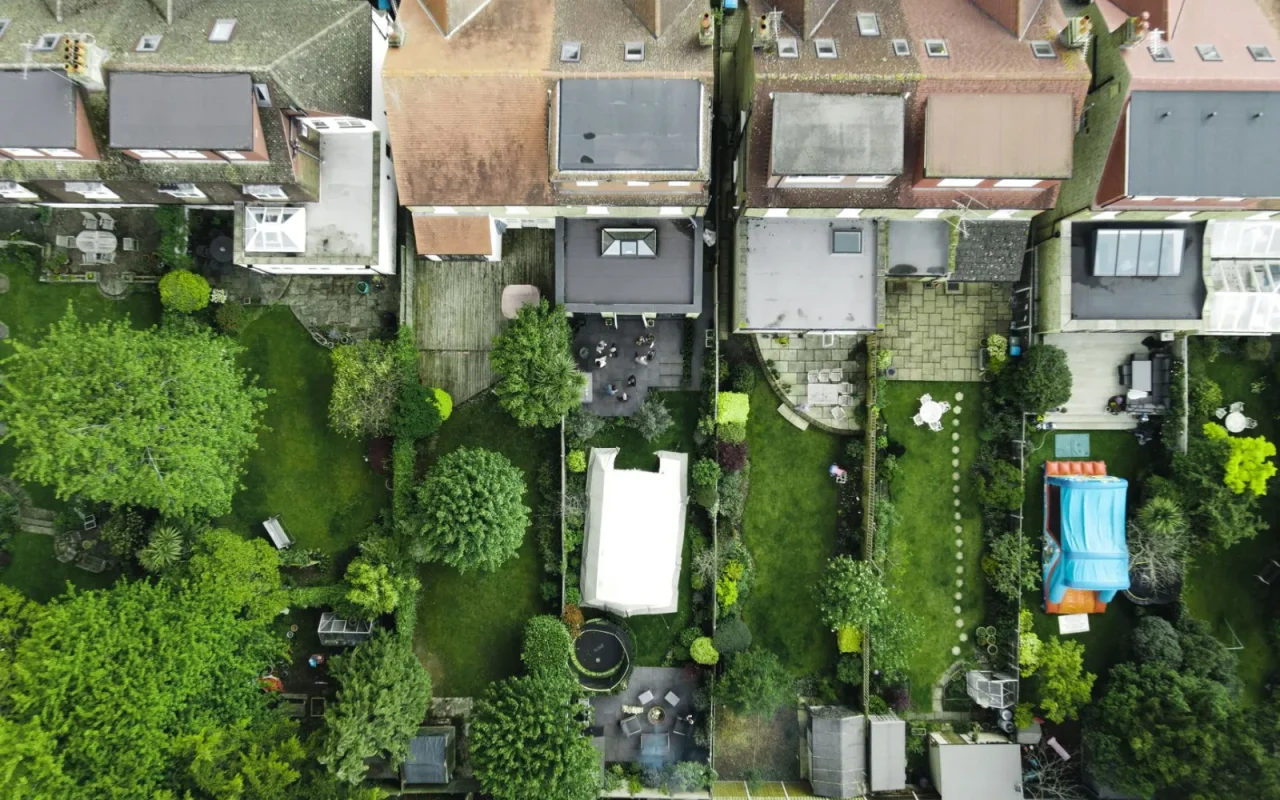
The reference station is the part people underestimate. It is a small antenna, often on a stake or mounted high on a wall or roof, and it needs an open view of the sky to lock onto enough satellites. Trees, eaves, and tall fences all block signal and degrade accuracy. Placement matters more than almost anything else in the install. On a wooded lot, a rooftop mount often works where a ground stake fails. The antenna also needs power and, on some systems, a link back to the base or mower. Get this piece right and the rest of the setup tends to fall into place.
Mapping Your Lawn Without a Wire
Instead of pegging wire, you teach an RTK mower the yard by driving or walking it around the perimeter once, usually through the phone app. You trace the outer border, then mark no-go zones around beds, ponds, and trees. The app stores this as a digital map you can edit later without touching the ground. Adding a new bed is a few taps rather than a rewiring job. This is the headline appeal of wire-free models: setup takes an afternoon, changes take minutes, and there is no loop to cut with a spade next spring. The map lives in software, so it moves and adapts with your lawn.
RTK GPS Setup Essentials
- A reference antenna with a clear, open view of the sky
- A stable mount, often a stake, wall bracket, or rooftop position
- Power and any required cable run to the antenna
- A charged mower with its own onboard GPS receiver
- The manufacturer app for tracing the lawn map
- A perimeter walk to record the outer boundary once
- No-go zones marked around beds, ponds, and trees
- A test mow to confirm accuracy near the borders
- Minimal tree canopy over the main mowing area
- A backup plan for shaded corners the signal cannot reach
- Firmware kept current for navigation improvements
- Patience during the first mapping session, which takes an afternoon
You will find more on this in How Robot Mower GPS Tracking Works.
Where RTK Struggles
RTK is not a cure-all. Its accuracy depends on a clear sky, so heavily shaded yards, narrow side passages between tall walls, and lots under dense tree canopy can leave the mower confused or drifting. Some models fall back to slower, less precise navigation in weak-signal patches, and a few simply refuse to mow there. Multi-story buildings and metal structures can bounce signals and cause errors too. If your yard is a leafy tunnel, a boundary-wire model may actually perform better. Honest sky assessment before buying saves disappointment, because no firmware update fixes a garden the satellites cannot see clearly.

It is worth skimming the technology inside robotic mowers for extra context.
Is an RTK Mower Worth the Money
RTK models sit in the premium tier, commonly $1,800 to $4,000 and up, and they earn that price on larger, open lawns of half an acre or more where wire would be a chore to lay and maintain. For a small, tree-ringed yard, a mid-range wire model at $800 to $1,800 often does the job for less hassle. The deciding factors are lawn size, sky openness, and how often you rearrange your beds. Big, sunny, and frequently changed points to RTK. Small, shady, and static points to wire. Match the technology to the ground rather than the brochure.
What to do next
Strip away the acronym and RTK is a simple idea done well: a fixed antenna corrects the mower's GPS in real time so it can trust a map instead of a wire. That buys you a fast install, easy edits, and no loop to slice with a shovel. The catch is the sky. These systems need to see the satellites, so a wooded or hemmed-in yard undercuts the whole approach. Stand where the antenna will live, look up, and be honest about what you see. That one glance tells you more about whether RTK fits your yard than any spec sheet ever will.
This connects neatly with Voice Control and Robot Mowers: Does It Work?.